
Project dossier
From acid sulfate soil at pH 2.5 to the first profitable vegetable crop — in 30 months, with data recorded every month.
For partners, organisations looking to replicate the model, and investors. Measured data, continuous field photography, and the mistakes as well.
Headline figures
- 6,0–6,5
- Soil pH, Zone 1
- 30months
- Remediation period
- 2.750kg
- First harvest yield
- 186%
- Return on experimental cost (owner's own labour not included)
Before: 2,5–3,0
Before: 0
Every figure is taken from the project's final report.
Capability
Thirty months, four stages
There was no breakthrough moment. Four stages back to back, each solving exactly the problem the last one left behind.
Stage 1 · Dec 2023 – Feb 2024
Infrastructure and subsoil remediation
Core infrastructure in place. Localised waterlogging dropped noticeably and the subsoil began to stabilise.
Stage 2 · Mar–Dec 2024
Biomass growth and organic matter build-up
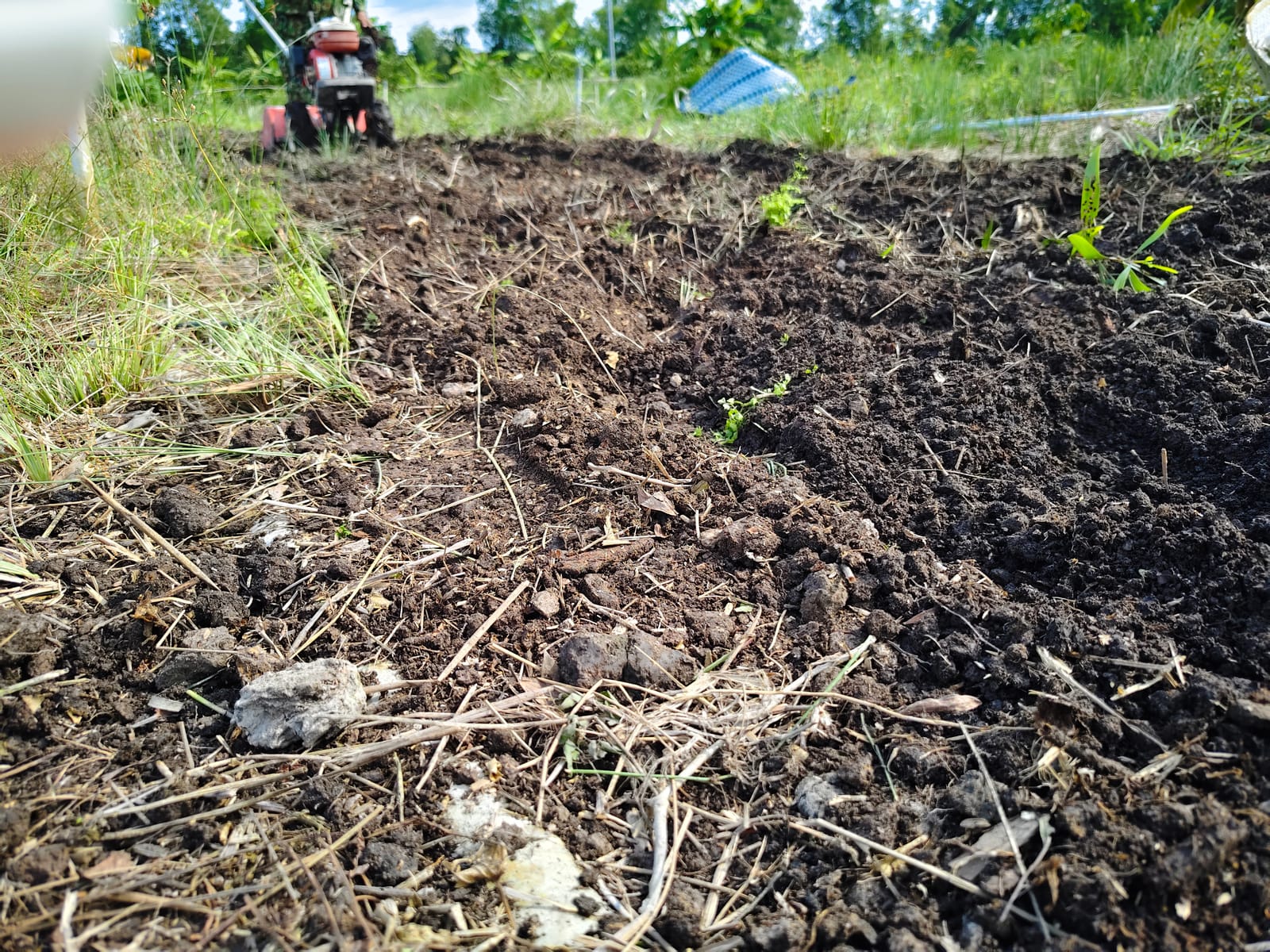
Soil turned darker, looser and better at holding moisture. Beneficial microorganisms began to appear.
Stage 3 · Jan–Dec 2025
Stabilising the soil ecosystem
Almost a total loss, with only the first batch of green papaya sold in time. But earthworms and beneficial insects had increased markedly, and the infrastructure held where it mattered: no bank collapse, no bed erosion. Once the water drained, planting could start again without rebuilding anything.
Stage 4 · Jan–Jun 2026
Validating production capability
Harvested 2,750 kg of produce — the first profitable crop since remediation began.
The model
Six components in a loop
What one component throws away, another needs. This is also the basis of the soil remediation service being handed over.
Short-cycle vegetables
Cucumber, bitter melon, gourds, luffa, winter melon, okra. The fastest source of cash, and a steady supply of green residue for composting.
Fruit trees and perennials
Banana, pineapple, jackfruit, guava, coconut. A long-term harvest, an on-site source of organic biomass, and a windbreak canopy.
Livestock
Chickens, ducks, wild boar, goats. They supply manure to the whole system and eat crop residues instead of bought-in feed.
Aquaculture
Using the pond system already dug during acidity remediation. Pond water and silt go back to the crops instead of going to waste.
Compost and biological inputs
Compost, biochar and microbial inoculants, all made from the residues of the other components. This is the link that closes the loop.
Processing and storage
Raising product value and cutting post-harvest loss. Whatever is rejected at this stage returns as animal feed and compost material.
Mission & vision
Soil is not something to conquer. It is something to listen to.
Mission
Our mission is to restore ground written off as dead — acid sulfate soil, exhausted soil, degraded soil — by finding and treating the root cause, instead of chasing solutions that only patch the surface.
We do not arrive to impose a formula on the land. We arrive to observe before we act, to unblock rather than force, to clear away whatever is holding back the flow of water, of air, of the microbial life already present in every handful of soil.
From two hectares of acid sulfate soil in the Plain of Reeds, where soil pH was brought from 2.5–3.0 up to around 6–6.5 over thirty patient months — not by magic, but by water, organic matter, microbial life and time — we carry the mission of extending this method to farmers, organisations and land still waiting to come back to life.
We publish what worked and what didn't, because truth is the only ground a long mission can stand on.
Vision
We picture a future where acid sulfate soil is no longer a life sentence, but an opportunity.
Where every degraded piece of land can recover its own capacity to heal, if people are patient enough to observe and humble enough to walk alongside it instead of controlling it.
Where a network of soil shepherds — farmers, scientists, businesses, a younger generation looking for meaning in their work — build together a way of farming that doesn't trade the future for this season's yield.
And further still, we picture a day when what we learned from the acid sulfate soil of the Plain of Reeds becomes a protocol we can hand on — to saline land, to exhausted land elsewhere, to people who have never met us but can still kneel down, put a hand in the soil, and begin their own journey of listening.
The final measure of that vision is not how many hectares were restored, but how many people learned to listen to the soil — and can carry that journey on without needing us anymore.
Listen to the soil to understand life.
Understand the soil to understand ourselves.
Walk alongside life, and build together a future that is more harmonious, more sustainable, and better.
Roadmap
Scaling on proven capacity, not on a plan on paper
2ha
In place — stabilised and in production
5ha
First expansion
10ha
Consolidated production zone
Want to know why this project exists?
Figures say what happened. They do not say why someone took on land everyone had written off. That part is on the blog.
Read the story